Given the equations of two lines, how can I find the intersection?
First, let's set up some criteria: we will be talking about two-variable
circumstances. That means that when graphed, these equations will be lines
graphed in a plane. (If you want to review more about
lines , try equation of a line or
linear or a powerpoint
slide about lines.)
| So, one of three conditions can exist: 1) the
lines will intersect at exactly one point or 2) the lines are
parallel and will not intersect, i.e. "no solution" or 3) the lines
coincide (same line) and have infinite solutions. Let's look
at these one at a time:
|
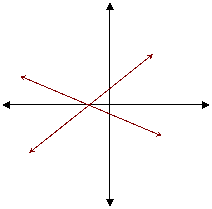
| 1) the lines intersect, at exactly one point. Lines
graphed as we have described do not bend so once they cross they
will not cross again. We use techniques such as substitution
or linear combination (elimination) in order to solve these.
|
 |
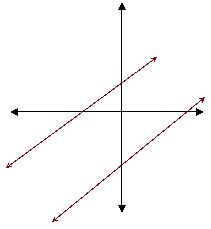
| 2) the lines are parallel and do not intersect. These
lines will have the same slope but different intercepts. |
 |
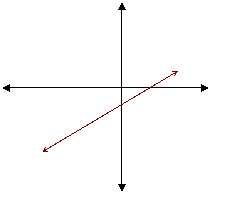
| 3) the lines coincide, they have the same points. These
lines (actually just one line) have the same slope and also the same
intercepts because they have the same points. |
 |
See linear combination or substitution
(body)
 how to have
success
in class
math links on the web
geometry
topics
algebra topics mixed
topics
Welcome letter
Math
1 Math
1 adv Math 2
adv Algebra
1 Hon Algebra
2 Hon
home
how to have
success
in class
math links on the web
geometry
topics
algebra topics mixed
topics
Welcome letter
Math
1 Math
1 adv Math 2
adv Algebra
1 Hon Algebra
2 Hon
home